
Cooking Line and Equipment
Degreasing focuses on accessible appliance surfaces, splash zones, equipment sides, removable parts, casters, and the floor beneath units when movement is safe and approved.
Serving Las Vegas, Nevada & surrounding areas
Restaurant Cleaning · Henderson
Detailed kitchen, dining area, and equipment cleaning planned around your operating hours, food-safety needs, and daily service demands.
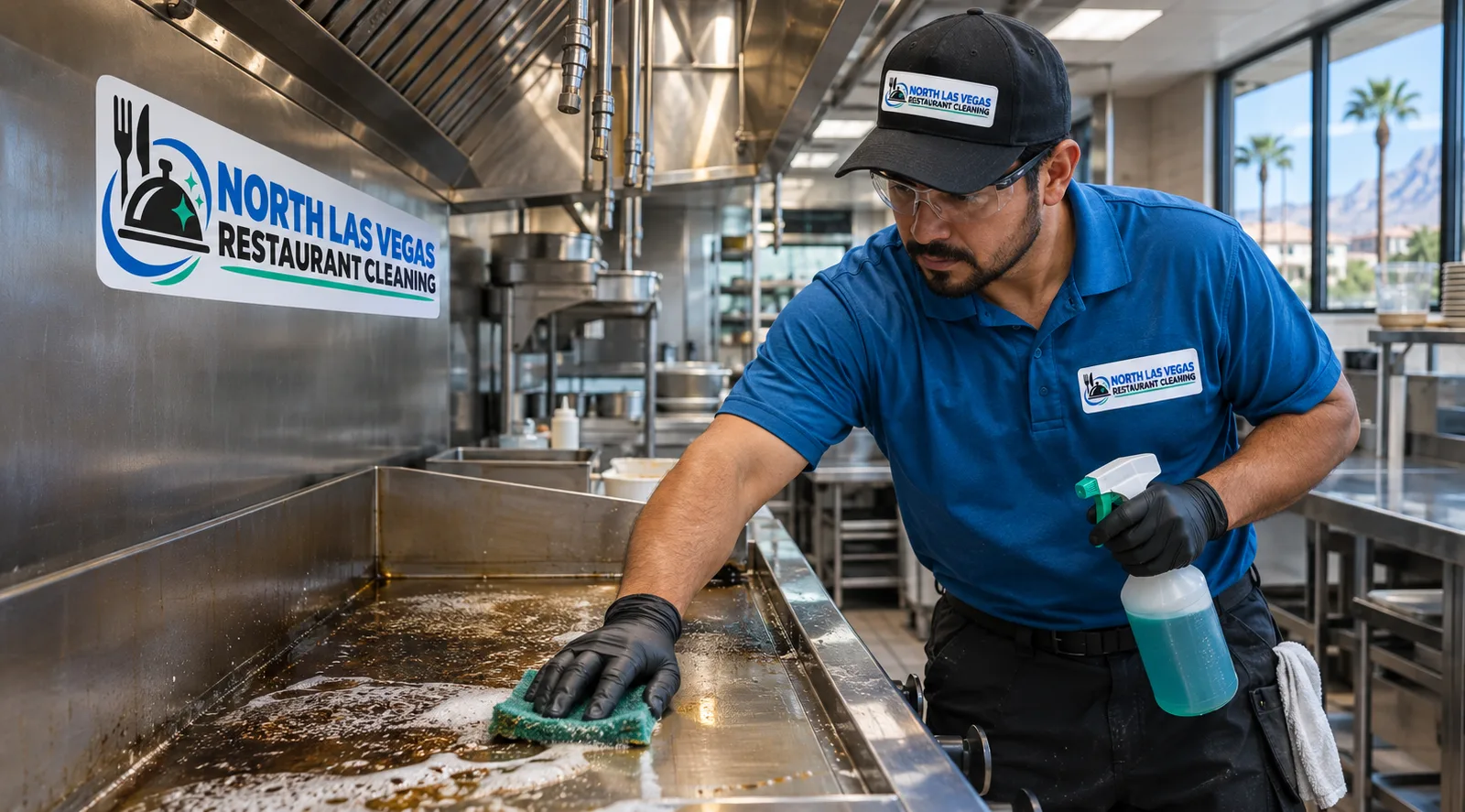
Cleaning planned around service
Restaurant Cleaning Henderson should support a safer, more orderly workplace without disrupting prep or guest service. North Las Vegas Restaurant Cleaning develops scopes for independent restaurants, quick-service kitchens, bars, cafés, and multi-unit operators. Work may include scheduled cleaning of cooking lines, equipment exteriors, floors, walls, prep areas, storage spaces, dining rooms, and restrooms.
Our team of restaurant service experts serving Las Vegas coordinates access, priority areas, and timing with managers before work begins. That planning matters for Henderson businesses near the Water Street District, where operating schedules may extend into evening events, and for restaurants around Green Valley Ranch, where dining rooms and open kitchens can shape the guest experience. Each scope identifies what will be cleaned, what must cool or be moved first, and which areas require special handling.
Desert dust can enter through doors, receiving areas, and ventilation pathways. In a working kitchen, airborne grease can then bind that fine debris to ledges, equipment sides, casters, and wall surfaces. A consistent cleaning schedule keeps the buildup manageable and makes neglected areas easier for managers to spot.
Equipment-specific methods
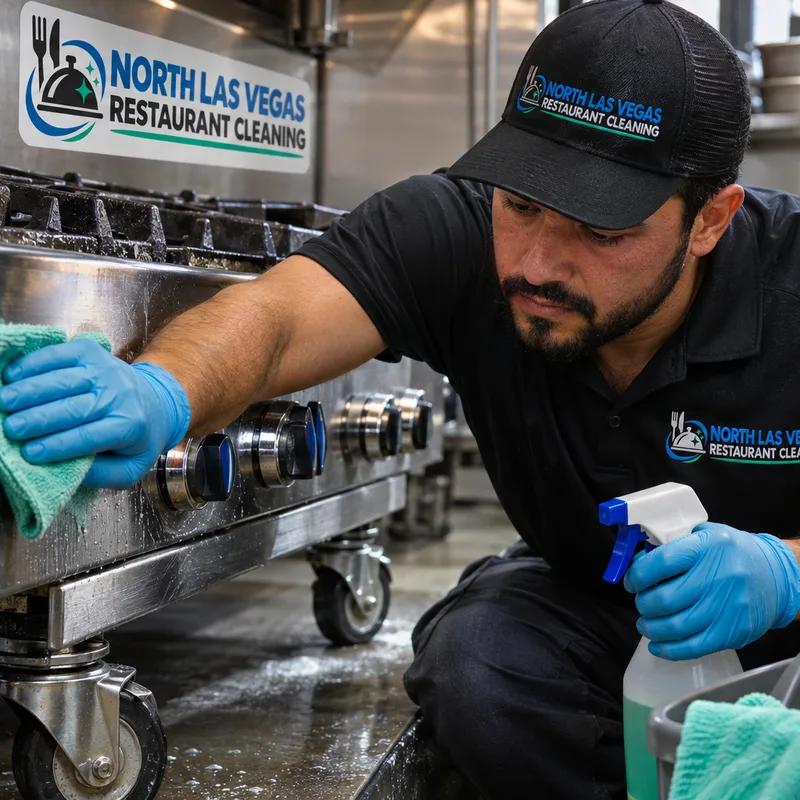
Detailed cleaning reaches removable parts, equipment edges, casters, and adjacent surfaces.
Restaurant equipment needs methods suited to its materials, construction, and use. Cleaning may cover cooktop surfaces, grates, removable components, fryer exteriors, ovens, stainless steel tables, refrigeration exteriors, shelving, casters, and the floor beneath movable units. Technicians use controlled dwell time to loosen grease rather than relying only on forceful scrubbing.
Sensitive parts require restraint. Control panels, ignition components, electrical connections, thermostats, motors, and refrigeration coils should not be saturated. Manufacturer instructions take priority when equipment has specific cleaning restrictions. Stainless steel is cleaned with nonabrasive tools and wiped with the grain to reduce visible scratching. Degreaser residue is removed before food-contact surfaces receive the final sanitation step appropriate to the operation.
Equipment cleaning is separate from mechanical repair and certified exhaust-system work. If a unit has damaged wiring, a gas odor, a failed seal, or another service issue, it should be assessed by the proper qualified technician. Likewise, grease removal inside ducts and rooftop exhaust components may require a specialist scope beyond routine kitchen cleaning.
Defined cleaning areas
Degreasing focuses on accessible appliance surfaces, splash zones, equipment sides, removable parts, casters, and the floor beneath units when movement is safe and approved.
Work can address tables, shelving, sinks, backsplashes, wall surfaces, floor edges, and other accessible areas where moisture, food debris, and grease collect.
Soil is loosened before floors are scrubbed, rinsed as appropriate, and left ready to dry. Attention to edges and areas beneath movable equipment reduces hidden residue.
Tables, chairs, ledges, hard floors, entry glass, and high-touch surfaces can be included so front-of-house spaces are ready for opening.
Fixtures, partitions, counters, touchpoints, and floors receive a defined cleaning and disinfection process, with chemicals given their required contact time.
Rotating tasks can cover vents, reachable high surfaces, storage shelving, baseboards, doors, and other areas that fall outside routine shift cleaning.
From walkthrough to review
Step 1 of 5
We review the kitchen, dining room, restrooms, storage areas, access points, and equipment included in the request. Managers can identify inspection concerns, recurring buildup, and surfaces that need manufacturer-specific care.
Step 2 of 5
The written scope separates routine tasks from periodic detail cleaning and lists exclusions. Timing is planned around closing, prep, deliveries, cooling equipment, and staff access.
Step 3 of 5
The restaurant removes or secures exposed food, utensils, packaging, and small wares as agreed. Technicians identify sensitive controls and confirm which equipment may be moved.
Step 4 of 5
Dry debris is removed first where appropriate. Chemicals are then applied at the correct dilution, allowed to dwell, and removed before final rinsing, wiping, sanitizing, or disinfecting steps.
Step 5 of 5
Priority areas are checked with the manager or designated contact. Any access limitation, damaged surface, or maintenance concern observed during cleaning is documented for follow-up.
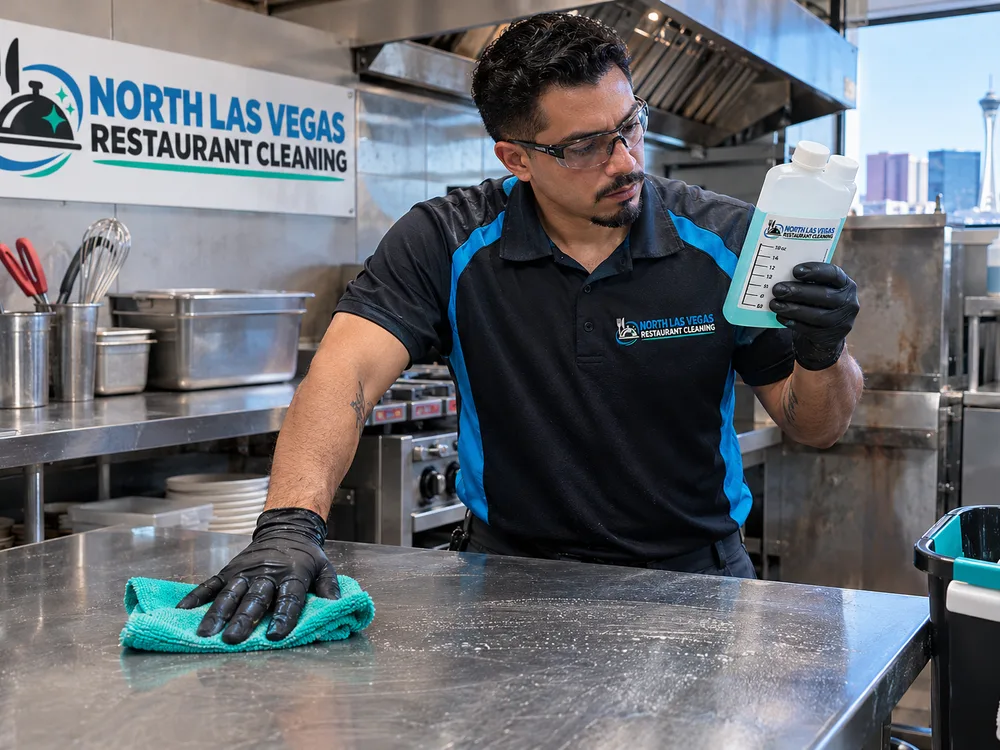
Product labels determine dilution, contact time, rinsing, and compatible surfaces.
Correct products and sequence
Cleaning removes grease, food residue, and other soil. Sanitizing reduces microorganisms on a cleaned food-contact surface when the correct product, concentration, and contact time are used. Disinfecting is generally reserved for compatible non-food-contact surfaces and also requires a pre-cleaned surface unless the product label states otherwise.
Chemical labels and safety data sheets guide dilution, personal protective equipment, contact time, rinsing, and surface compatibility. Products used around food preparation must be appropriate for the intended surface and applied according to label directions. Mixing chemicals is unsafe, particularly products containing bleach with acids or ammonia.
Clark County food establishments operate under Southern Nevada Health District oversight. A professional cleaning plan can support an establishment's sanitation procedures, but it does not guarantee an inspection result or replace employee food-safety duties. Managers remain responsible for temperature control, cross-contamination prevention, pest reporting, and the daily practices required by their operation.
Request a CallbackMatch service to soil load
The right frequency depends on cooking volume, menu, hours, equipment layout, and the strength of the restaurant's in-house closing routine. A high-output fryer line usually needs more frequent degreasing than a low-grease beverage counter. Open kitchens may also need shorter intervals because equipment exteriors and surrounding surfaces remain visible to guests.
Routine service can focus on floors, restrooms, touchpoints, and exposed surfaces. Periodic detail visits can rotate equipment pullouts, shelving, wall areas, vents, and hard-to-reach edges. One-time deep cleaning may make sense before an opening, after construction dust has been contained and removed, during a management transition, or when deferred buildup has exceeded what a closing crew can reasonably handle.
Henderson covers several distinct operating settings. Water Street restaurants may need access coordinated around events and late service. Green Valley and Anthem dining businesses often depend on careful front-of-house presentation, while operations near major corridors such as Sunset Road may have heavy delivery and takeout activity. The useful distinction is operational: traffic patterns, grease production, and available downtime determine the schedule.
Henderson pricing factors
Restaurant cleaning in Henderson typically ranges from $300 to $1,200 per visit. A smaller recurring service may fall near $300 to $600, while a detailed kitchen and equipment deep clean can run $700 to $1,500 or more. These are general estimates, not fixed quotes.
Final price depends on square footage, grease buildup, equipment quantity, access, cleaning frequency, operating schedule, and whether dining rooms or restrooms are included. Heavy scraping, equipment movement, and overnight work can add labor. Exact cost is confirmed after a walkthrough or detailed scope review.
Prepare with confidence
Get a written cleaning scope that identifies priority equipment, service frequency, access needs, and what your staff should prepare before the crew arrives.
Request a CallbackScope, access and scheduling
Yes, cleaning can often be scheduled after closing or during another low-activity period, subject to crew availability and facility access. Henderson restaurants should allow enough time for hot equipment to cool, food to be secured, floors to dry, and opening staff to regain access.
A focused small-kitchen visit may take several hours, while a larger kitchen, dining room, and equipment scope may require a full shift or staged visits. Grease level, equipment movement, square footage, and access around Water Street or other active commercial areas can affect the schedule.
Equipment included in detailed cleaning usually must be shut down, cooled, and made safe according to manufacturer instructions. The restaurant should confirm shutdown procedures for fryers, ovens, grills, and gas or electric appliances; technicians should not disconnect utility-fed equipment unless that task is explicitly approved and properly qualified.
Accessible exterior surfaces, handles, gaskets, shelving, and empty interior areas may be included when agreed in advance. Food must be removed or protected, temperatures must remain controlled, and electrical or refrigeration components cannot be saturated. Coil cleaning or mechanical service may require a qualified refrigeration technician.
Yes, when the unit can be moved safely without straining gas lines, electrical connections, plumbing, or flooring. The walkthrough identifies castered equipment, fixed units, anti-tip restraints, and items that require a qualified trade to disconnect before Restaurant Equipment Cleaning Henderson work begins.
No, a cleaning company cannot guarantee an inspection result. Southern Nevada Health District inspections consider food handling, temperatures, employee practices, pest activity, facility condition, and sanitation. Detailed cleaning supports a restaurant's program but does not replace management controls or staff training.
Recurring service is usually the better fit when grease, floor soil, and guest-area use return quickly between shifts. A one-time deep clean suits openings, transitions, or deferred work. Many Henderson operators use a recurring core schedule with rotating detail tasks for equipment sides, storage, and reachable high surfaces.
Start with a clear scope
Tell North Las Vegas Restaurant Cleaning about your kitchen, equipment, hours, and priority areas. We will help define a practical scope before work is scheduled.
Restaurant cleaning in Las Vegas
Tell us about your kitchen, dining room, schedule, and priority areas so we can help define a practical cleaning scope.
Request a quote
After you submit the form, our team will review your details and contact you to discuss the property, priorities, and next steps.